build
a structured mirror
Prizerv
An AI self-transformation tool, grounded in positive psychology.
what it is
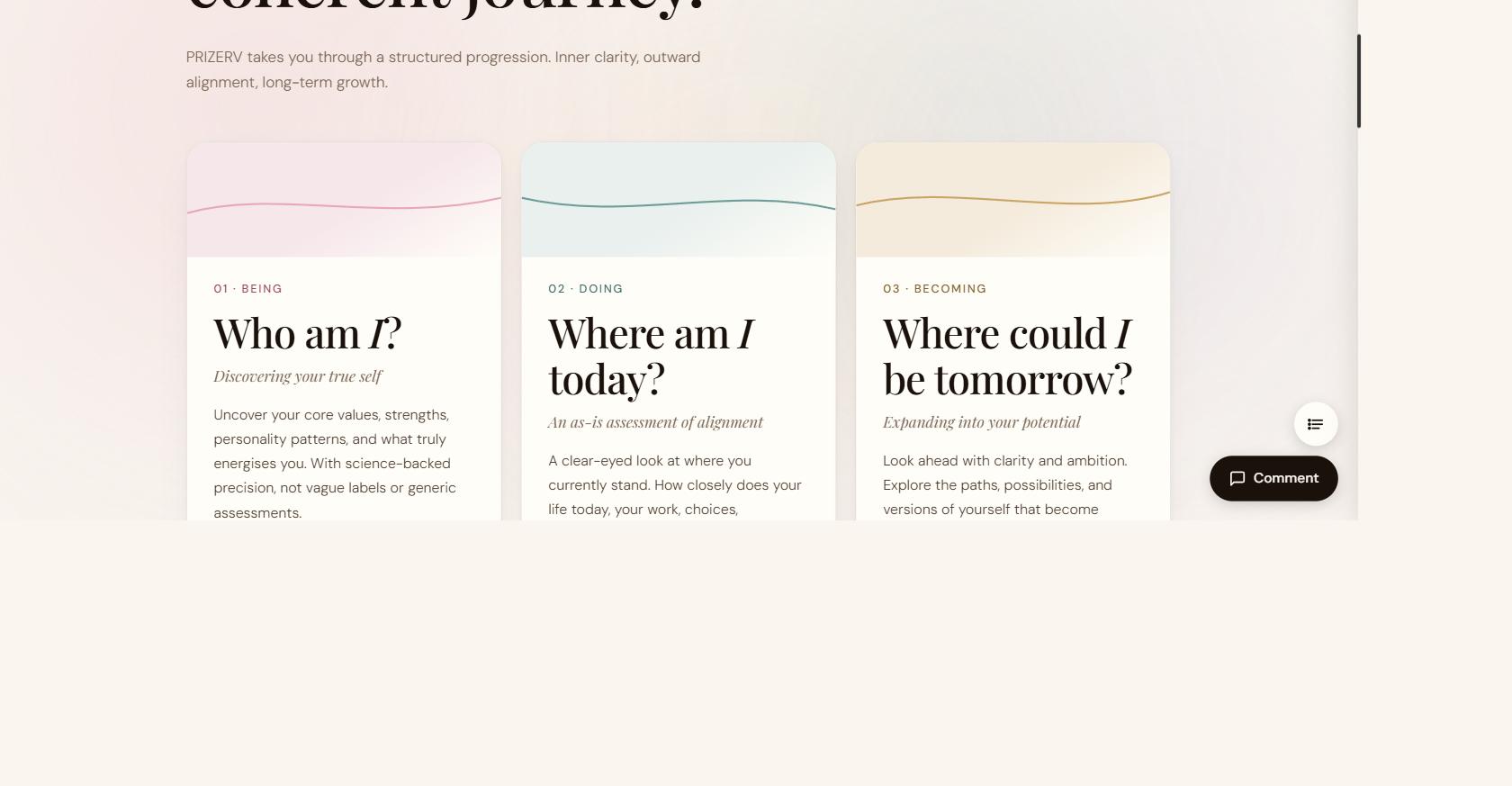
The most ambitious of these builds: an AI-powered self-discovery platform. Not therapy, not a personality test, but a structured mirror that walks you through a full arc, who you are, how you are actually living, and how to close the gap between the two. Three phases, Being, Doing, Becoming, each one built on the last.
what is unique
The ambition is the integration. Most tools do one of these jobs; Prizerv attempts the entire arc in a single adaptive session, each phase consuming the last one's output. It is AI-led, not assessment-led: no static question battery, the AI runs the conversation and adapts in real time, drawing on Big Five, PERMA, positive psychology, and flow. And it mirrors rather than defines, reflecting patterns back tentatively instead of scoring you, which is far harder to hold together than a quiz.
how it was built
Built with a two-agent workflow, Claude as planner and Claude Code as builder. The prompts started life as Word documents co-designed with a psychologist, the actual framework for what a session should draw out, in what order, and how to score it. Design language is Living Dark, a warm near-black base, two typographic voices, motion that feels like breath.
my learnings
The AI quoting itself back as the user's own words
Some reports displayed a quote in the user's own voice that the user never actually said, at least one of them was the product's own prior sentence, laundered through the pipeline and handed back as someone's private insight. The instinct was to fix it in the prompt, tell the model to only quote verbatim, but a rule like that had already been silently ignored more than once on the same codebase before it was taken seriously. The real fix was a byte-exact checker: code that only trusts a quote if it can find those exact words, unparaphrased, inside what the person actually typed. Prompt instructions and a hard structural check are different classes of defence, and for anything attributed to a real person, only the second one holds.
The test method that quietly broke the thing it was testing
For a while, testing meant pasting a whole fake conversation into one message box and letting the app process it, the fastest way to generate test data. The problem: the app stored that entire paste as if it were one message from the user, meaning the fake half written by the AI itself sat inside a row labelled as the user's own words. That meant the same verbatim-quote checker above certified the product's own writing as real user speech, because structurally, that is exactly what it looked like. Caught by building a proper test harness that writes fake conversations directly and correctly, then re-running the checker against both versions of the same content and watching it flip the right way. Your test data generation method can be the exact source of the bug you are trying to catch.
Why the sessions sounded like a survey
The first version fed the psychologist's own design document straight into the model as its live instructions, 7,000-plus words of structured tables covering per-turn choreography, scoring rubrics, and question menus. It ran that way for about six weeks. The sessions worked, technically, but read like a form: evaluative openers, menus of feelings, one construct after another in the document's own marching order. The report generator, a single free-form generation with no such structure, already sounded genuinely good, which proved the model itself was not the problem. The fix was a full rewrite of the runtime prompt: no zones, no menus, follow the person instead of the agenda, and it was not a straight cut, an early draft was tested offline at under half the eventual length, then grew back to nearly double that once real testing surfaced what the minimal version was missing. The same swap also broke report generation for a day, since both had quietly been sharing one prompt function, caught by comparing report length before and after, and fixed by splitting the two apart for good. Sounding human was the hardest thing in the build, harder than any of the plumbing. A self-discovery tool lives or dies on whether the output feels genuinely personal rather than generic AI output, which is the pitch a lot of AI products end up having to make. More than twenty prompt iterations went into it and none of them were really about the model.
The build with the least obvious buyer
This is the most ambitious thing I have built and the one I would find hardest to sell. The three-phase session is genuinely useful, and the market for it is thin, badly defined, and crowded at the cheap end by personality quizzes promising the same thing for free. I could argue myself into a route to market, but I would be arguing. So I will say it plainly: this is the one I would struggle to sell.
from the live build
01 / 04
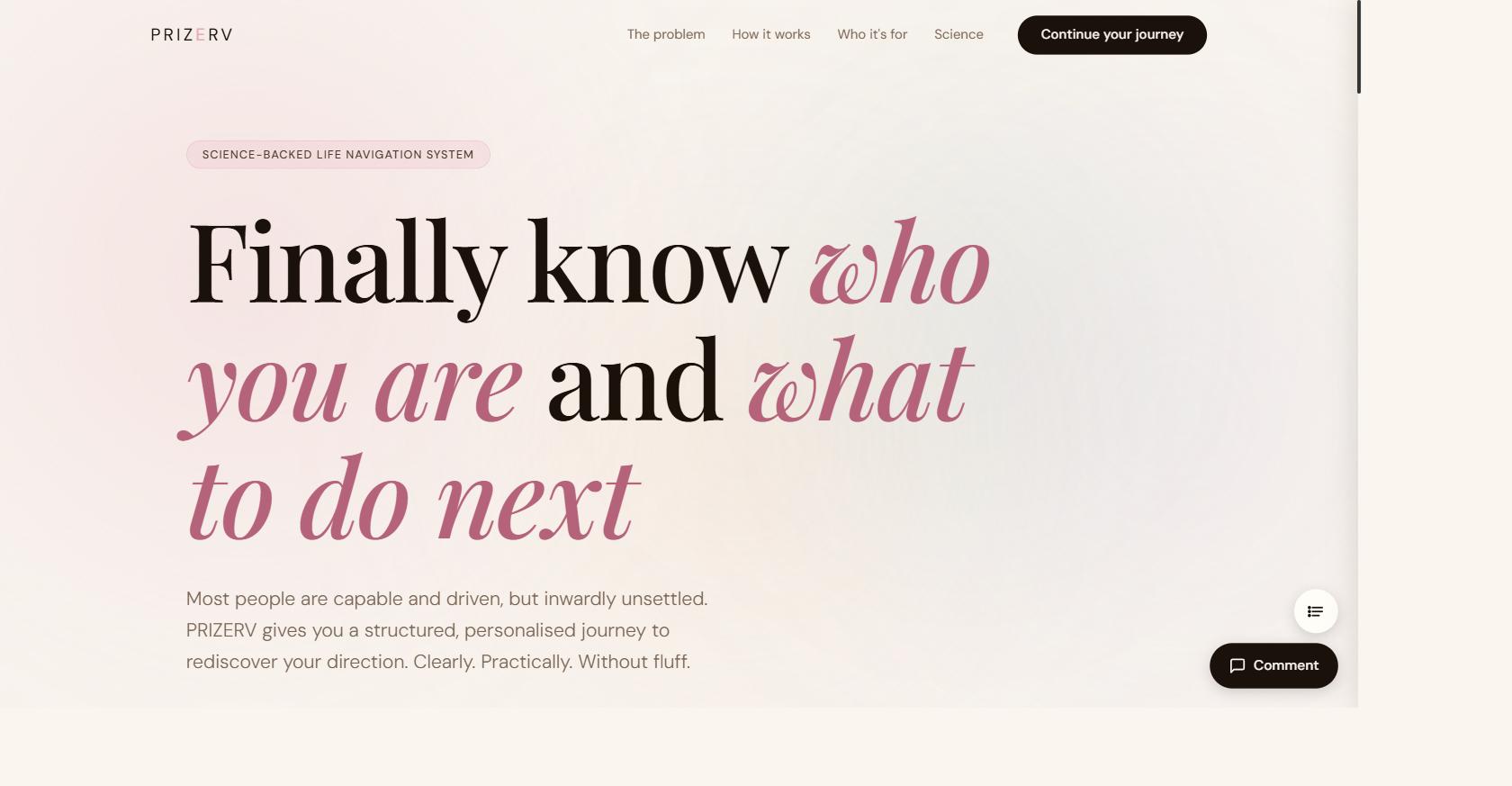
The pitch: a structured, personalised journey to rediscover direction, without the fluff.
02 / 04
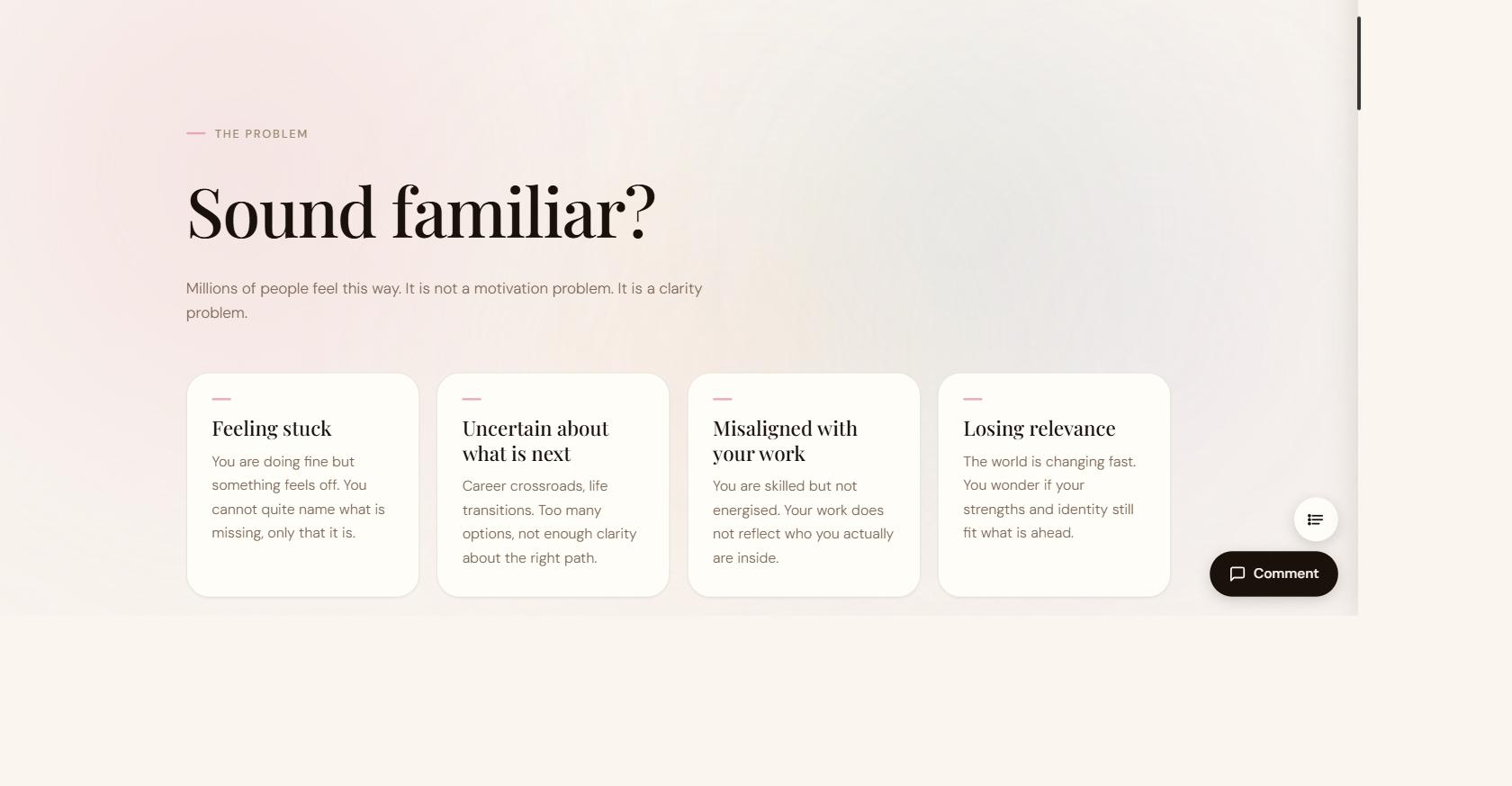
Who it is for: feeling stuck, uncertain about what is next, misaligned with your work, or losing relevance.
03 / 04
Being, Doing, Becoming: the three-phase arc, each phase built on the last.
04 / 04
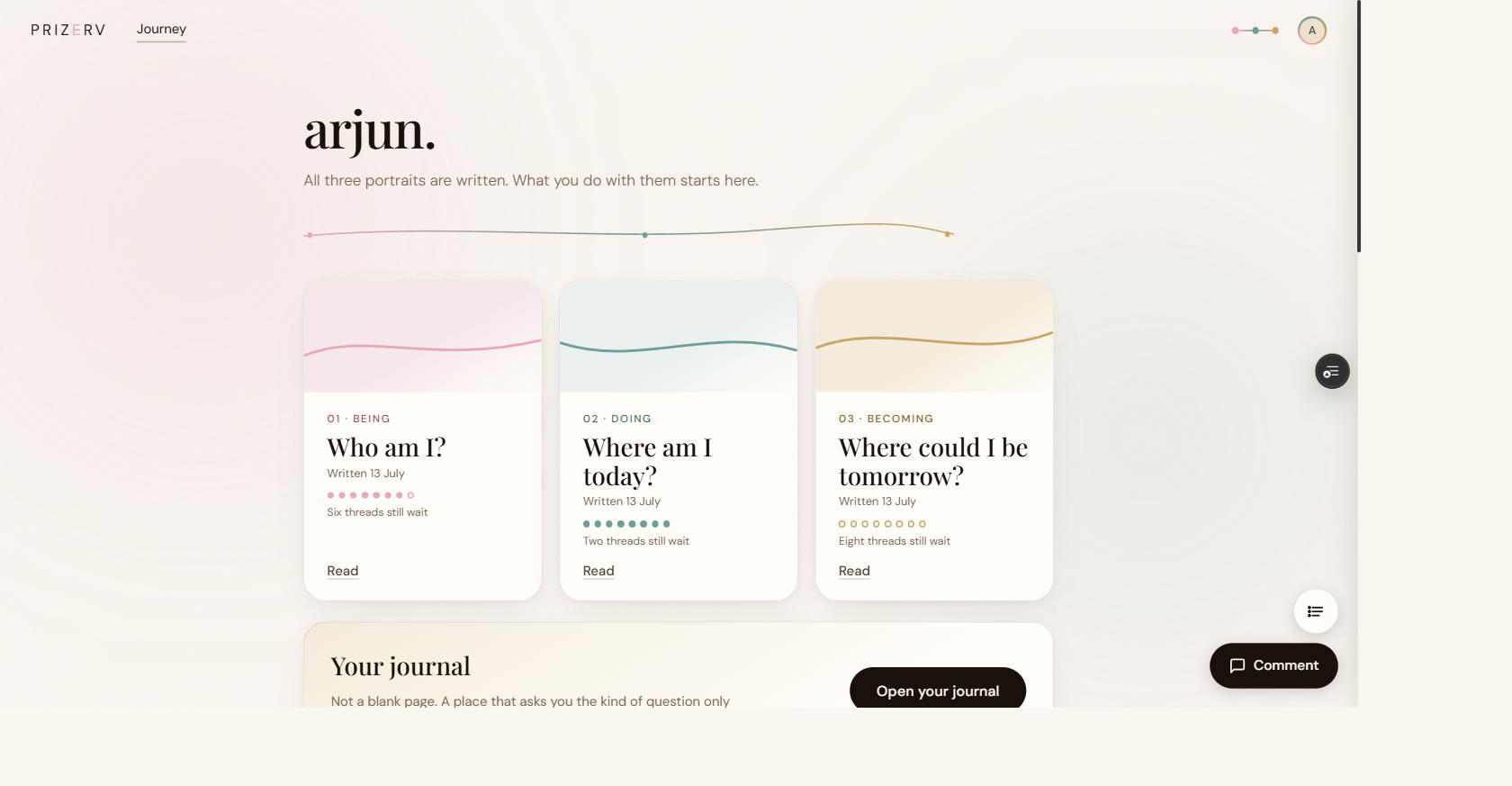
A real completed journey (name and initial changed): all three portraits written, with concrete experiments queued up next.