consulting
Slurrp Farm
AI powered business intelligence for a $90M consumer foods brand.
the problem
A $90M consumer foods brand had its customer signal (reviews, search, social mentions, competitor moves) in different places, read reactively, if at all.
why it hurts
Reading it by hand is slow, and one dashboard that everyone reads through their own bias ends with nobody acting. The founder listening to the market and the brand team testing an idea before spending on it need different answers.
what i built
Two AI tools on one corpus of 15,000-plus customer verbatims. Mill pulls what customers say across the big quick-commerce and marketplace platforms into one corpus, with every claim traceable to the sentence behind it. Kernel, an AI agent, tests a product idea against it and returns a sourced case for and against. I pitched it to the founders directly and built it end to end with AI; I had worked at Slurrp Farm early in my career.
how it works
Fewer, sharper claims.
whyOne dashboard that everyone reads through their own bias ends with nobody acting.
A separate tool for each real job.
whyThe founder listening to the market and the brand team testing an idea before spending on it need different answers.
Let code do everything a model should not.
whyRetrieval, counting and checks are code. The writing model sees only a frozen evidence pack, so it cannot invent a customer or a number.
in detail
Two tools on one shared corpus. Each has a distinct job, and neither decides for you.
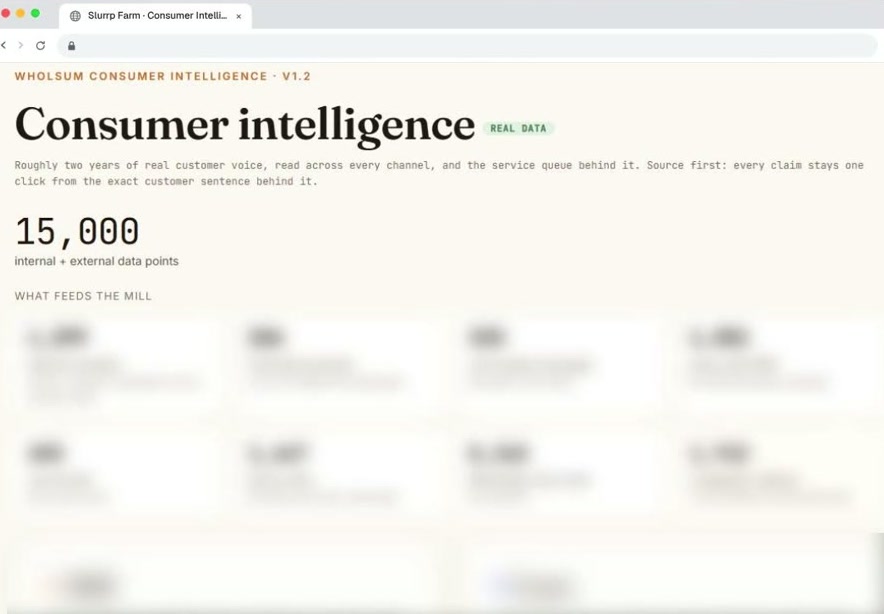
Mill
Social listening on steroids: what customers say about Slurrp Farm across the big quick-commerce and marketplace platforms, in one corpus, segmented into trends, with every claim traceable to the sentence behind it.
Individual source counts held back at the client's request.
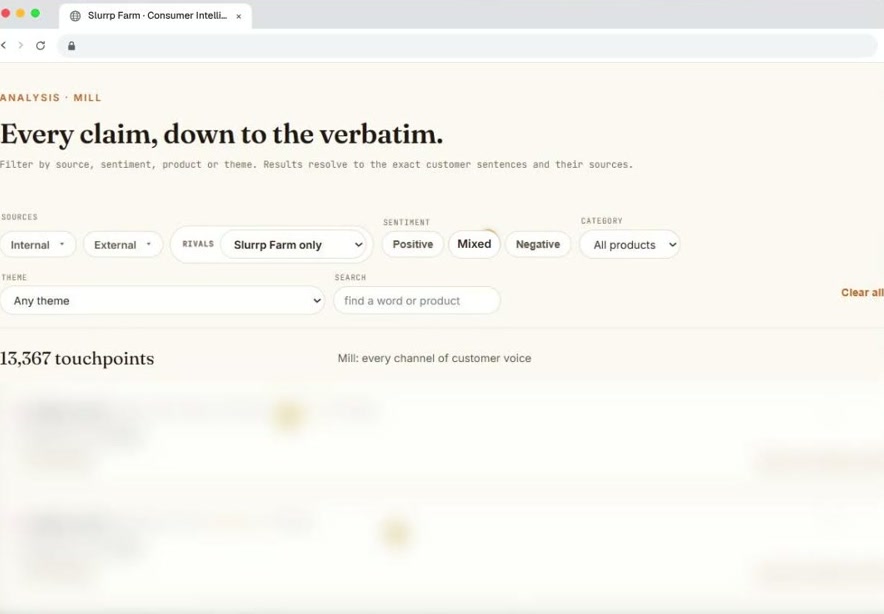
Every claim, down to the verbatim
Filter by source, sentiment, product or theme, and every result resolves to the exact customer sentence and its source.
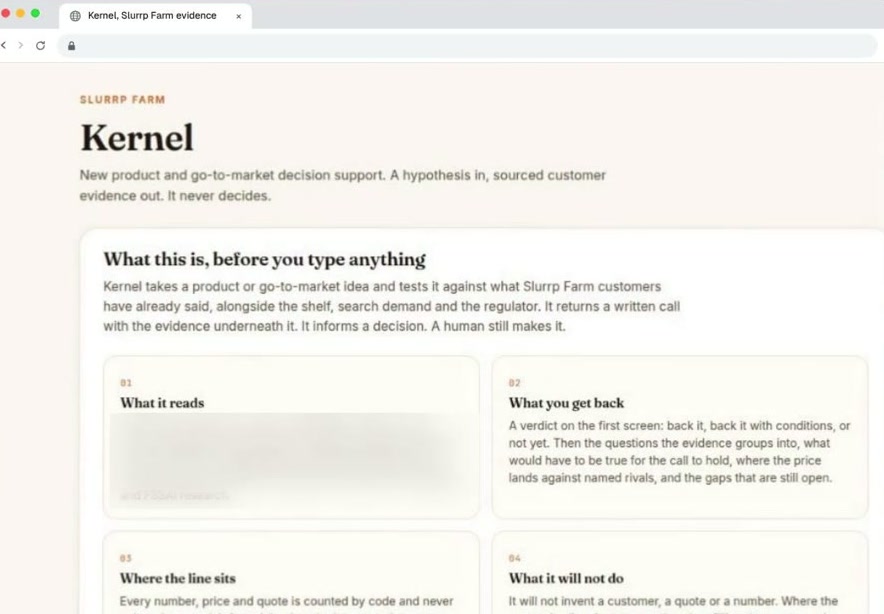
Kernel
A product manager types a hypothesis, say a single-serve millet cookie pack for school tiffin boxes, and Kernel answers from real customer reviews: a sourced case for and against, a go-to-market plan and a confidence-rated verdict.
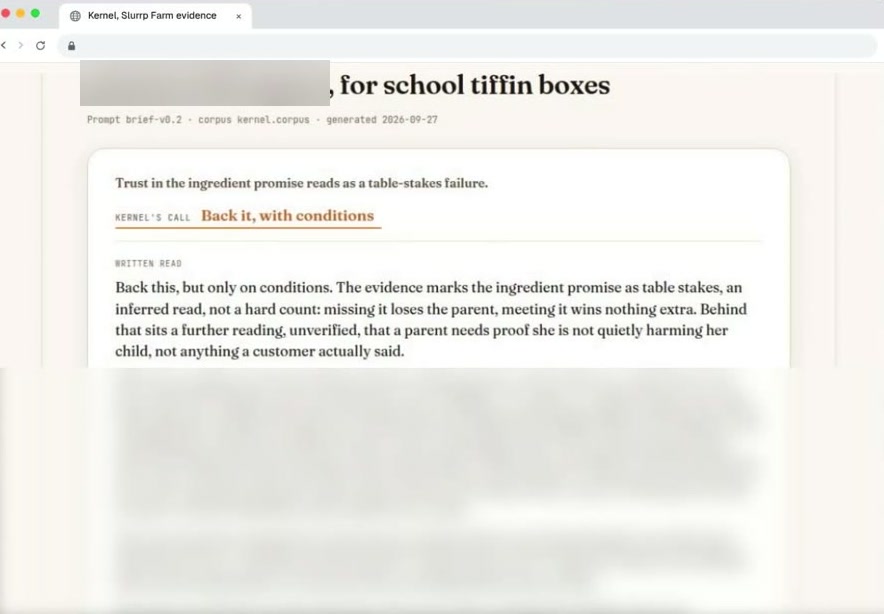
The call, from the evidence alone
The writing model sees only the frozen evidence pack and may not add a number, a customer or a quote. In this run, fifteen checks passed before the call was shown.
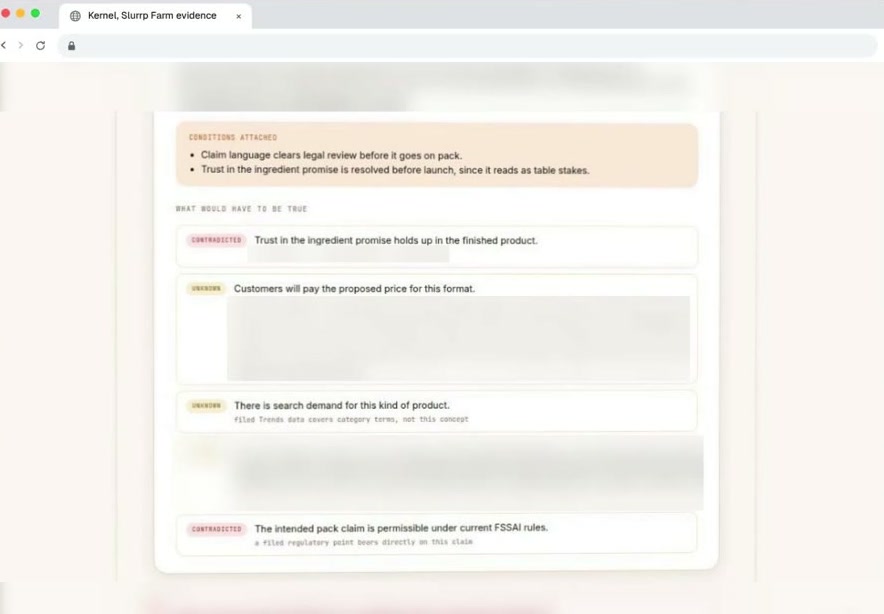
What would have to be true
The call comes with its conditions, and each assumption it rests on is marked against the evidence, contradicted or still unknown.
why it's useful
The founders hear the market in one place, and the brand team can test an idea against what customers already said before spending on it. Every claim traces to the sentence behind it, and the writing model cannot invent a customer or a number.
outcomes
- Mill: est. 60% faster discovery of new category insights, 2x faster actioning of adverse customer events.
- Kernel: est. 3x more product ideas properly evaluated per planning cycle, 50% faster first-pass hypothesis assessment.
3 months
to deliver two AI tools, Mill and Kernel, handed over with a runbook and now used by the founder, insights and GTM teams
15,000+
verbatims in one corpus, every claim traceable to its source
technical specs
- Kernel: Postgres full-text retrieval, then a model extracts closed-taxonomy tags and verbatim excerpts in batches, code counts frequencies and confidence bands, a second model writes from that frozen pack alone, code gates the result, and a person decides.
- About 35,000 lines of Python. An agentic version that chooses its own next step runs beside the fixed pipeline, which is kept as the baseline it is measured against.
- The checks are sorted by what they protect: a fabricated quote withholds the whole pack; a banned word warns and still delivers.