build
Lever
An AI tool that shows mid-market owners where AI actually applies to their business.
what it is
A single-page diagnostic tool that helps UK mid-market business owners find where AI actually applies to their business. Answer eight to twelve questions, get a prioritised list of five to eight AI integration opportunities tailored to the business, each with a plain-language explanation, a complexity rating, and a typical ROI range. An ROI calculator and a contact step sit below.
what is unique
The entry point. Most AI-adoption tooling assumes the buyer already knows enough to ask build-versus-buy or which vendor. Lever starts a step earlier, at what AI can even do for this business, which is the highest-value, least-served gap. The tool never tries to give a final answer, it opens doors: the free tool surfaces opportunities, the ROI calculator creates urgency, the contact step captures qualified leads.
how it was built
A short question set maps a business onto a taxonomy of AI use cases, and the tailored brief streams back as it generates rather than leaving the owner staring at a blank screen.
my learnings
The fix was deleting the step, not tuning it
Pre-generating every brief in parallel produced intermittent timeouts. First I staggered the calls, on the theory that simultaneous starts were spiking a rate limit. It helped and it did not fix it. Logging showed the real shape: the taxonomy was being serialised with fields the matching step never reads, so every call was carrying far more input than it needed against a tight per-minute token ceiling. Stripping those fields and adding prompt caching cut the payload by roughly two thirds, and under real load it still fell over. What worked was deleting the pre-generation entirely and streaming each brief on click instead: a few seconds slower to reach, and a screen that stopped timing out. Two partial fixes in a row was the signal I should have read earlier. I was making a wasteful step cheaper instead of asking whether it needed to run at all.
The tool had to start a step earlier than the sale
Most of the owners I spoke to could not yet ask build versus buy, so a tool that opens there is answering a question its buyer has not reached. Lever deliberately starts a step earlier, at what AI can do for this business at all, with complexity and a return range attached so the answer is usable rather than flattering. The bet is that meeting owners at the question they can actually ask, rather than the one a vendor wishes they were asking, is where trust in this market starts.
from the live build
01 / 04
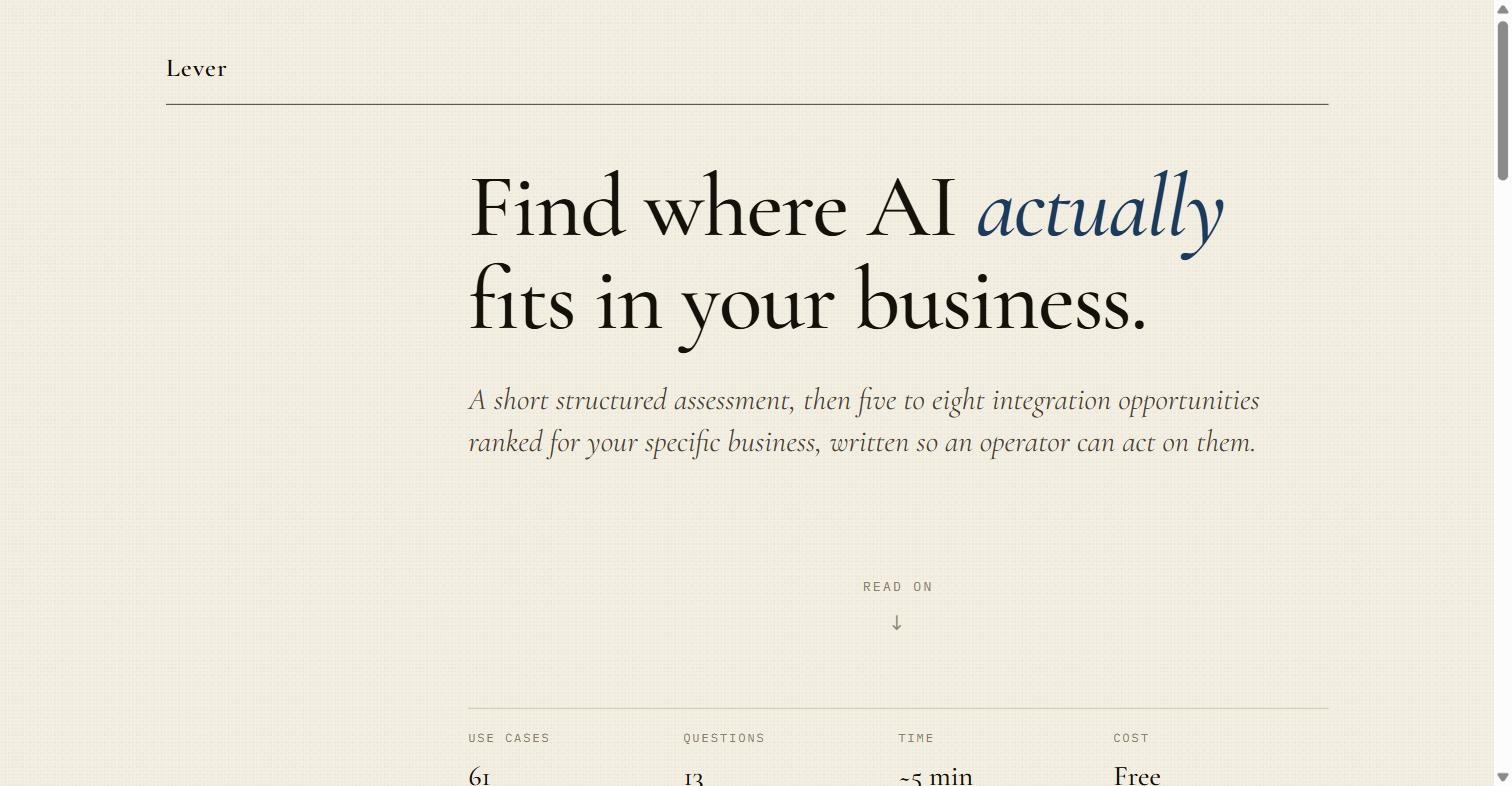
The offer in one screen: a short structured assessment, then a ranked set of integration opportunities written so an operator can act on them.
02 / 04
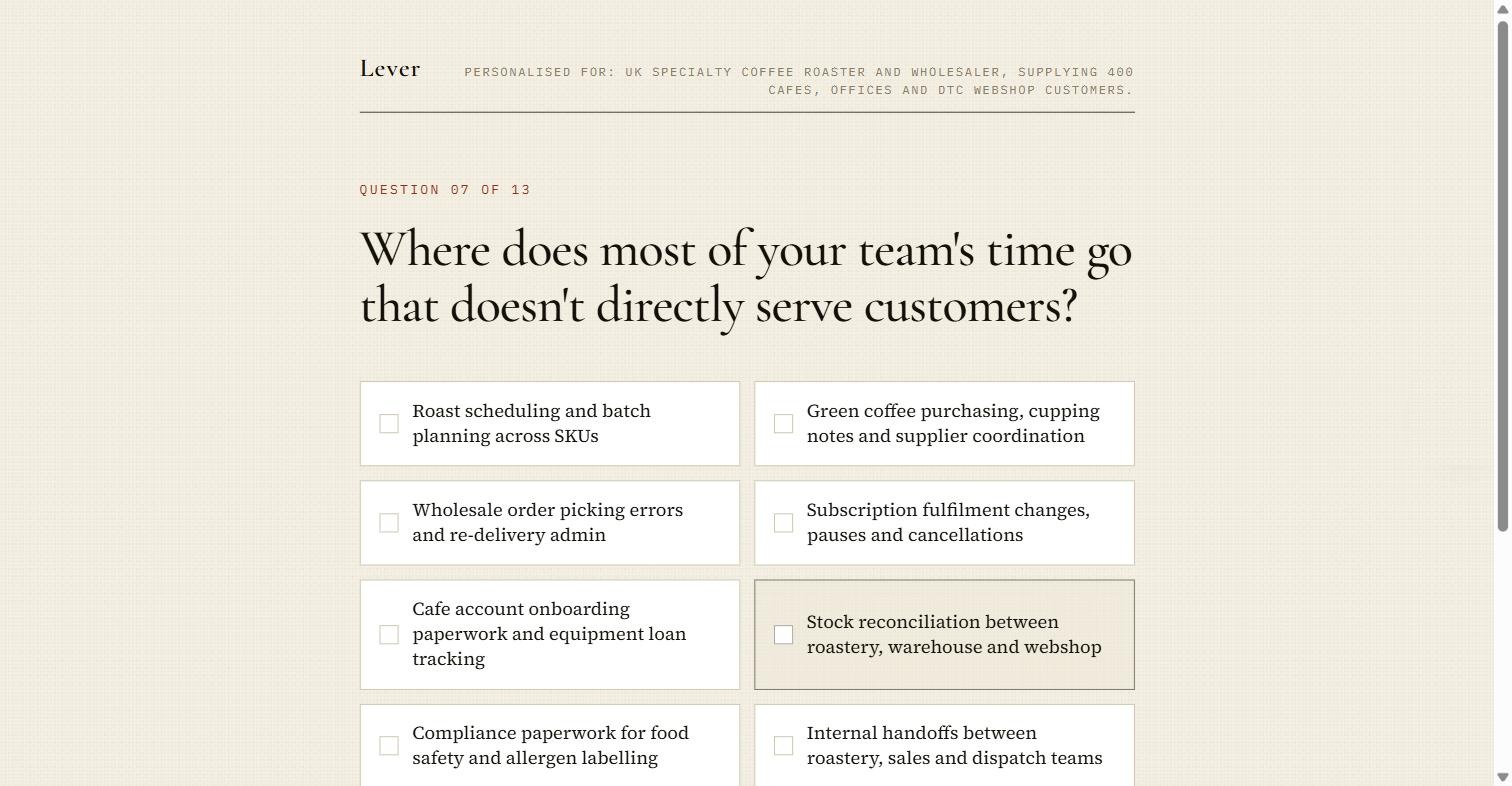
The assessment rewrites itself around the business you describe. Say you roast coffee and the options come back as roast scheduling and green coffee purchasing, generated rather than picked from a list.
03 / 04
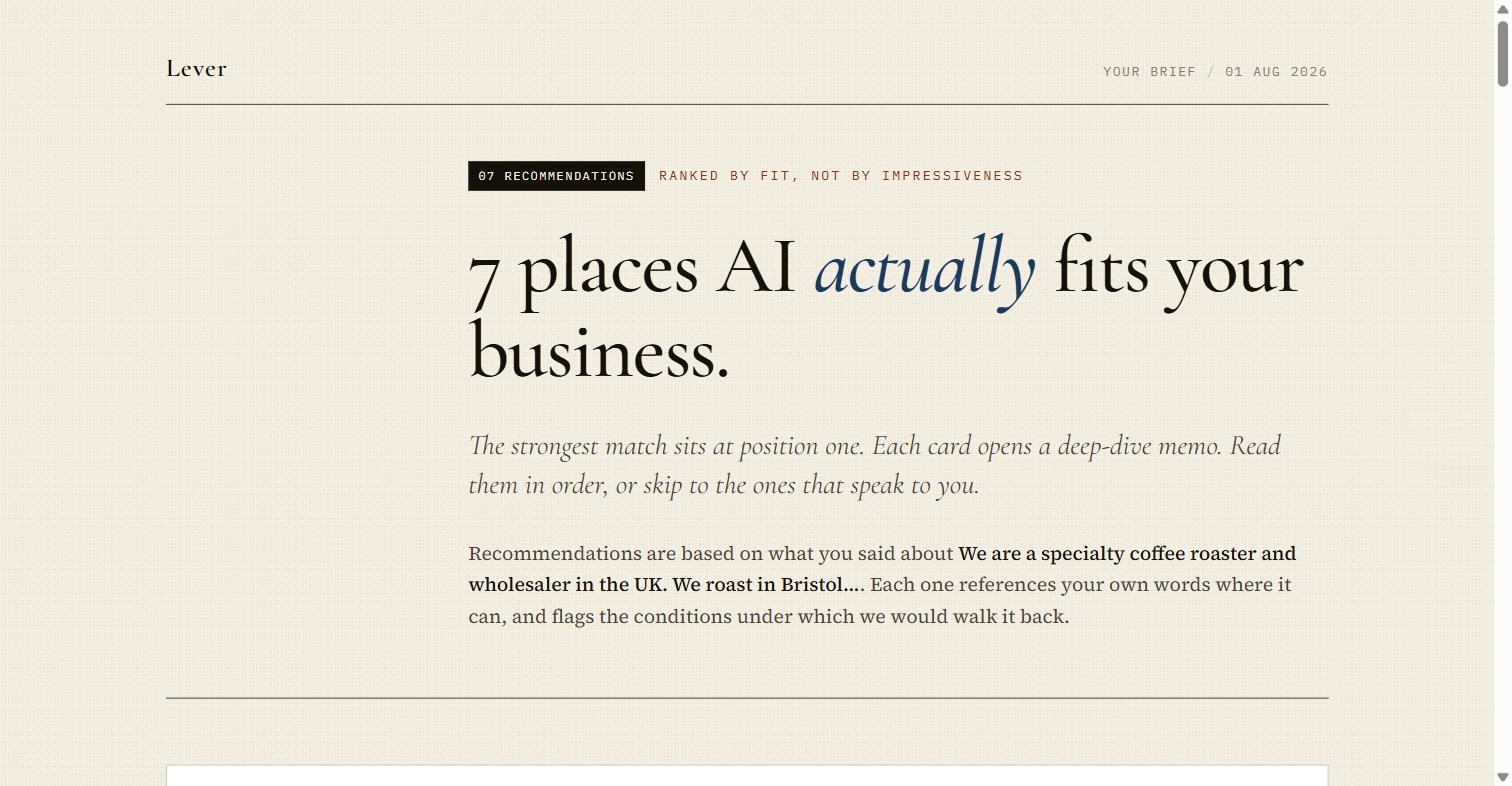
Seven opportunities, ranked by fit rather than by how impressive they sound, each built from the owner's own words and each flagging the conditions that would sink it.
04 / 04
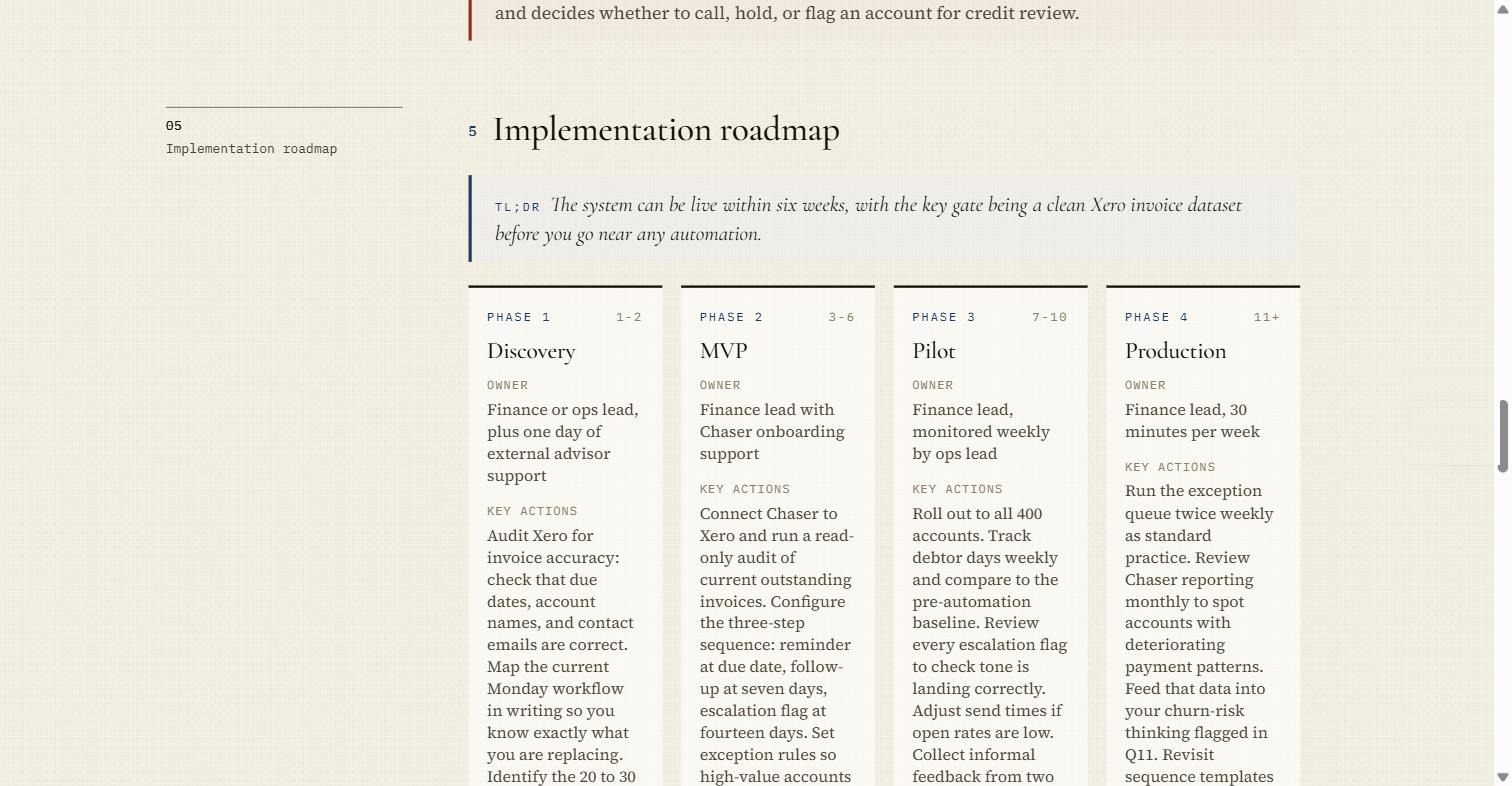
Every recommendation opens a deep dive, and the roadmap inside it runs four phases with an owner and a time cost on each, so the plan is something a business can actually staff.
live site
Visit the live site↗