build
Kairos
AI cultural event discovery for London. Spotify for live culture.
what it is
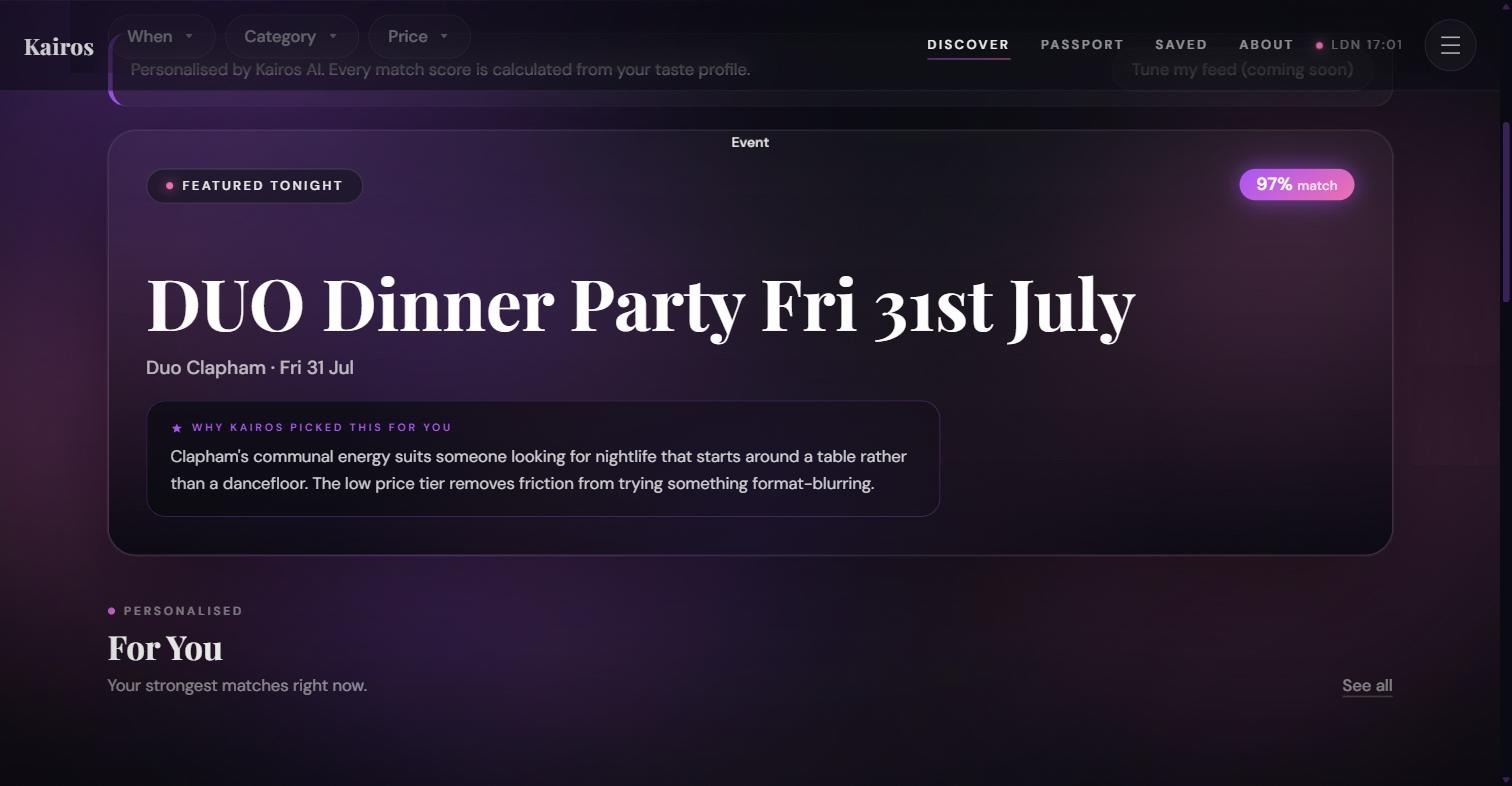
AI-powered cultural event discovery platform for London, positioned as Spotify for live culture. A swipe-style taste quiz builds a personalised event feed with match scores, each backed by an AI-generated explanation of why the event fits.
what is unique
The gap it is built on. Music, comedy, theatre, art, techno: in the UK each of these largely sits behind its own app or its own site, and none of them talk to each other, so there is still no default place to ask what is on tonight. The category is consolidating now, Fever bought DICE in June 2025, but consolidating ticketing is not the same as winning discovery, and nobody has won discovery. On top of that gap sits the discovery layer, which is the actual edge rather than inventory or ticketing: an LLM enriches each event with vibe tags and social context, the quiz becomes a multi-dimensional taste vector, and a transparent scoring formula ranks against it. Every recommendation comes with a written reason, which makes it read less like a listings site and more like a knowledgeable friend with taste.
how it was built
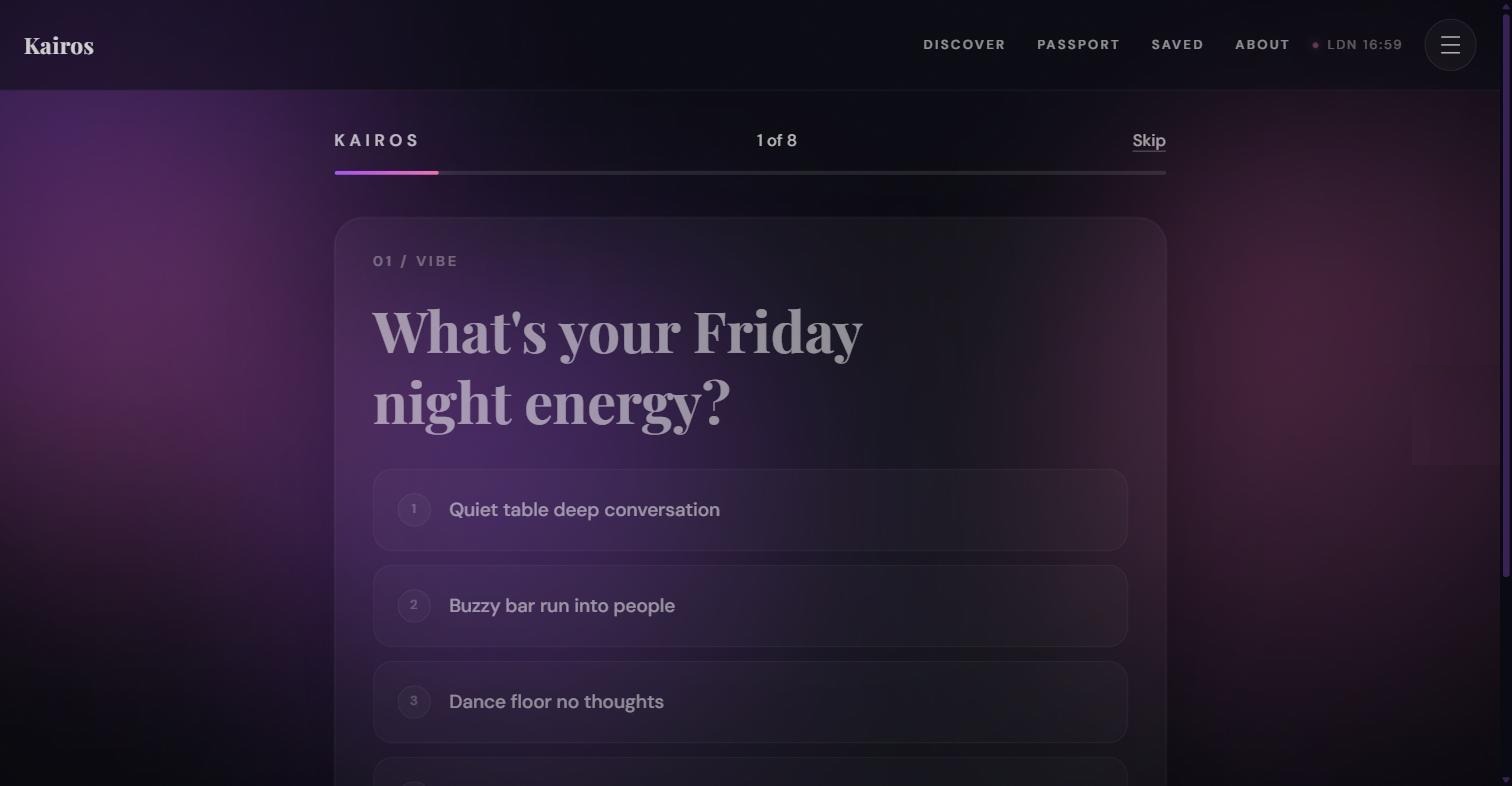
A recommendation engine, not a chatbot. An eight-question quiz becomes one embedding, matched against a Pinecone index of 400 real London events by plain vector similarity, no live model call sits in the request path. The "why this suits you" copy per event is pre-written offline in batches by Claude against the real event data, not generated per user, which keeps live requests fast and cheap.
my learnings
The product works. The revenue mechanics are the existential question.
Kairos solves a real problem and I still do not think that is what decides whether it becomes a business. Discovery creates the demand and then hands the transaction to Ticketmaster or Skiddle, who own the checkout and keep the customer, so the value created is high and the value captured is thin. Affiliate commission is the obvious answer and I do not think it carries a business on its own: a few percent per ticket, paid by whoever owns the checkout, which is also whoever keeps the customer. The trap underneath is that the fragmentation making the product necessary is the same thing denying it pricing power, because the promoters who most need the traffic are the least able to pay for it. So the question was never whether people like the feed. It is whether Kairos ever comes to own the transaction or the audience relationship, and until there is an answer to that, this is a good product rather than a company.
Images that failed silently
Some event photos rendered as blank space instead of falling back to a placeholder. The standard way of catching a broken image, listening for an error event, never fired, because some of the source CDN's responses came back as a technically successful, empty response, not a real failure. Fixed by checking the image's actual rendered width instead of trusting the error event. That fix is very likely why the later rebuild stopped hotlinking third-party images at request time altogether and started downloading and self-hosting every event photo during the data pipeline instead, removing the whole failure class rather than patching around it.
Rebuilding the entire dataset without breaking anything that used it
The first version ran on 300 AI-generated events, plausible fake London nights with AI-generated photos to match. It worked and shipped. Months later it was replaced completely: real Ticketmaster and Skiddle listings, real venues, real ticket links verified against live responses, real photos pulled from the actual listings, a genuine rewrite of the entire data layer. The brief for that rewrite explicitly ruled out touching the recommendation route at all, so the interface the rest of the app depended on never moved while everything behind it did.
Tuning the ranking away from what the data wanted
Plain similarity ranking let the big Ticketmaster listings crowd out the smaller, more interesting nights, which is accurate and useless: a feed of arena shows is not a product anyone needs. The scoring carries a deliberate multiplier for niche events to correct for it. That is the judgement a recommendation product eventually forces on you, and it is not a technical one. The most accurate ranking and the most useful one are not the same ranking, and that is a business call, not a modelling one,.
from the live build
01 / 03
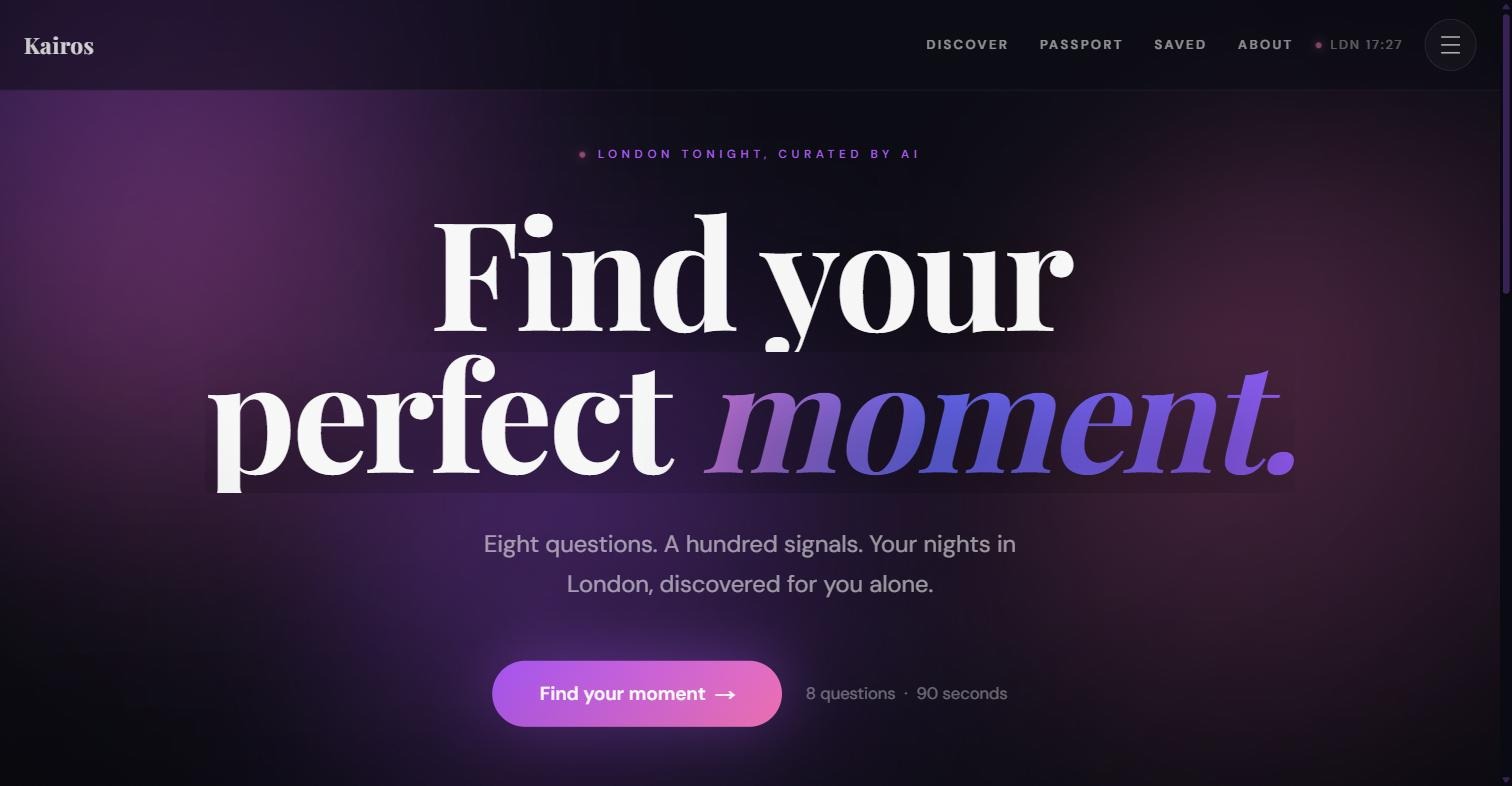
Eight questions, ninety seconds, then a feed of London nights built for one person.
02 / 03
The quiz opens on vibe rather than category, because how you want a night to feel predicts more than what genre it is filed under.
03 / 03
Every match carries a score and a written reason for it. The reason is the product: a bare percentage does not tell anyone whether to go.
live site
Visit the live site↗