consulting
Business school AI strategy
An AI strategy for a business school: three moves in order, and a working prototype of the first.
the problem
A business school's careers advisors each cover a few industries and a group of students, and much of what they know sits in their head, their inbox and a spreadsheet.
why it hurts
Good roles get buried in one long weekly email sent to everyone, and a student who has gone quiet is easy to miss.
what i built
An AI strategy of three moves in a deliberate order, with a list of what to skip, and a working prototype of the first: an advisor cockpit, employer and alumni pages, and a short list of fitting roles for each student. I proposed the strategy after a discovery call with the team and built the prototype.
how it works
Nothing that needs institutional sign-off to begin.
whyThat ruled out replacing the school's platform or needing data on day one, and pointed to a memory aid for the people already doing the work.
Remind the advisor, and never contact anyone.
whyThe tool never contacts a student or an employer. The advisor does.
Show the reason behind every flag.
whyAn advisor who cannot see the reasoning will not trust it.
in detail
Three moves, each earning the next, and a prototype of them. Every record in it is invented, and a bar on every page says so.
Where to start today
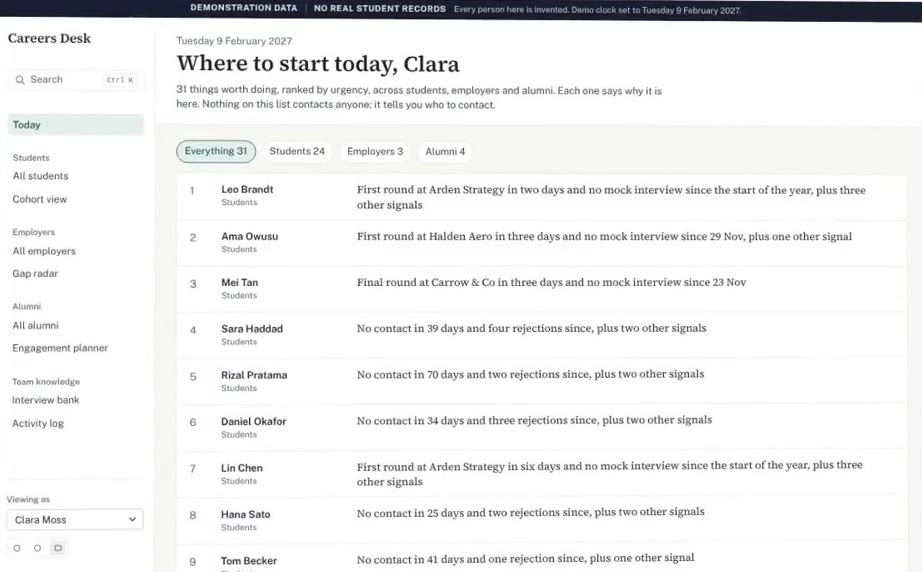
One list each morning across students, employers and alumni, ranked by urgency, each item saying why it is there. Nothing on it contacts anyone.
One page per student
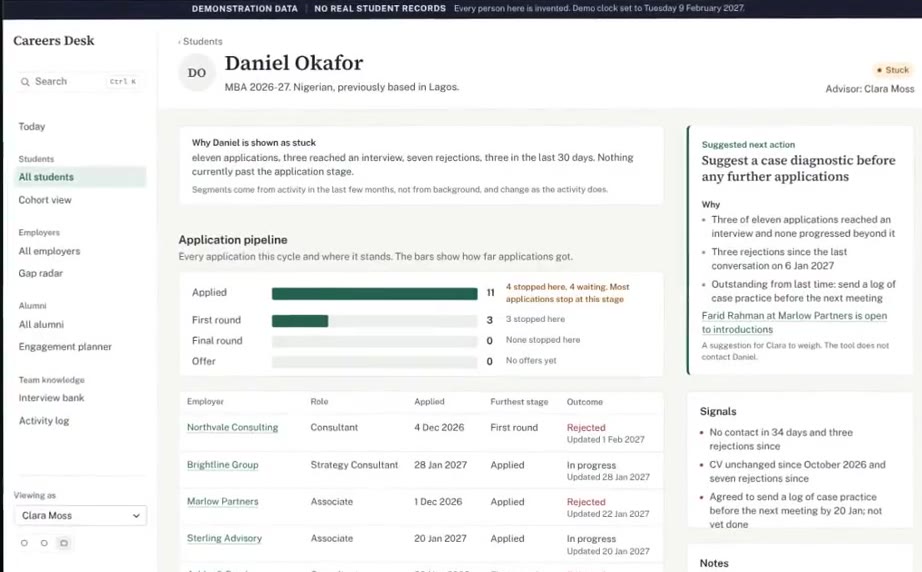
Goals, what was said last time, what to do next, and who has gone quiet, each flag with a plain reason.
The cohort, by behaviour
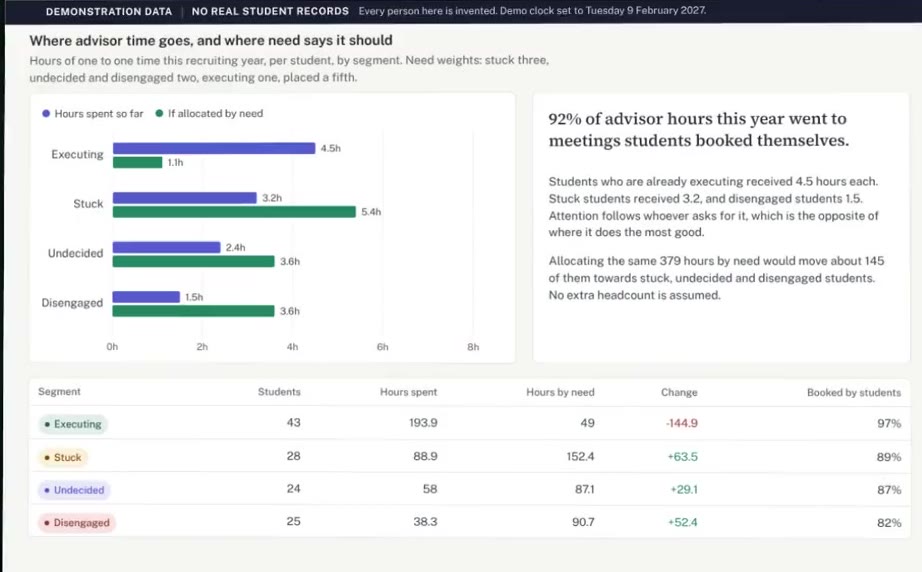
Students grouped by what they are doing (executing, stuck, undecided or disengaged), where each group drops out, and where advisor time goes set against where need says it should.
Gap radar
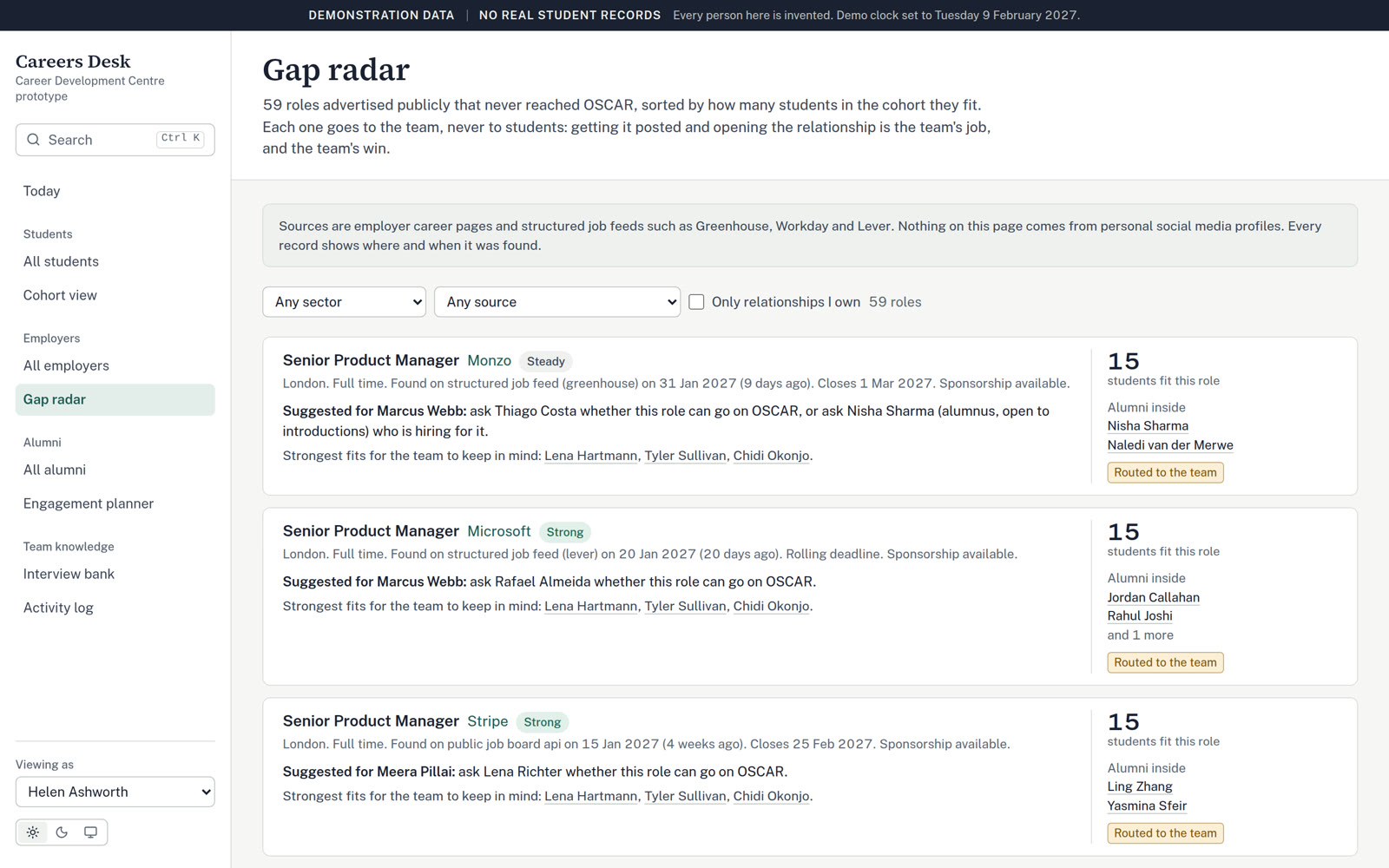
Roles advertised publicly that never reached the school's jobs board, sorted by how many students in the cohort fit each, with the alumni inside and a suggested ask. Each one goes to the team, never to students.
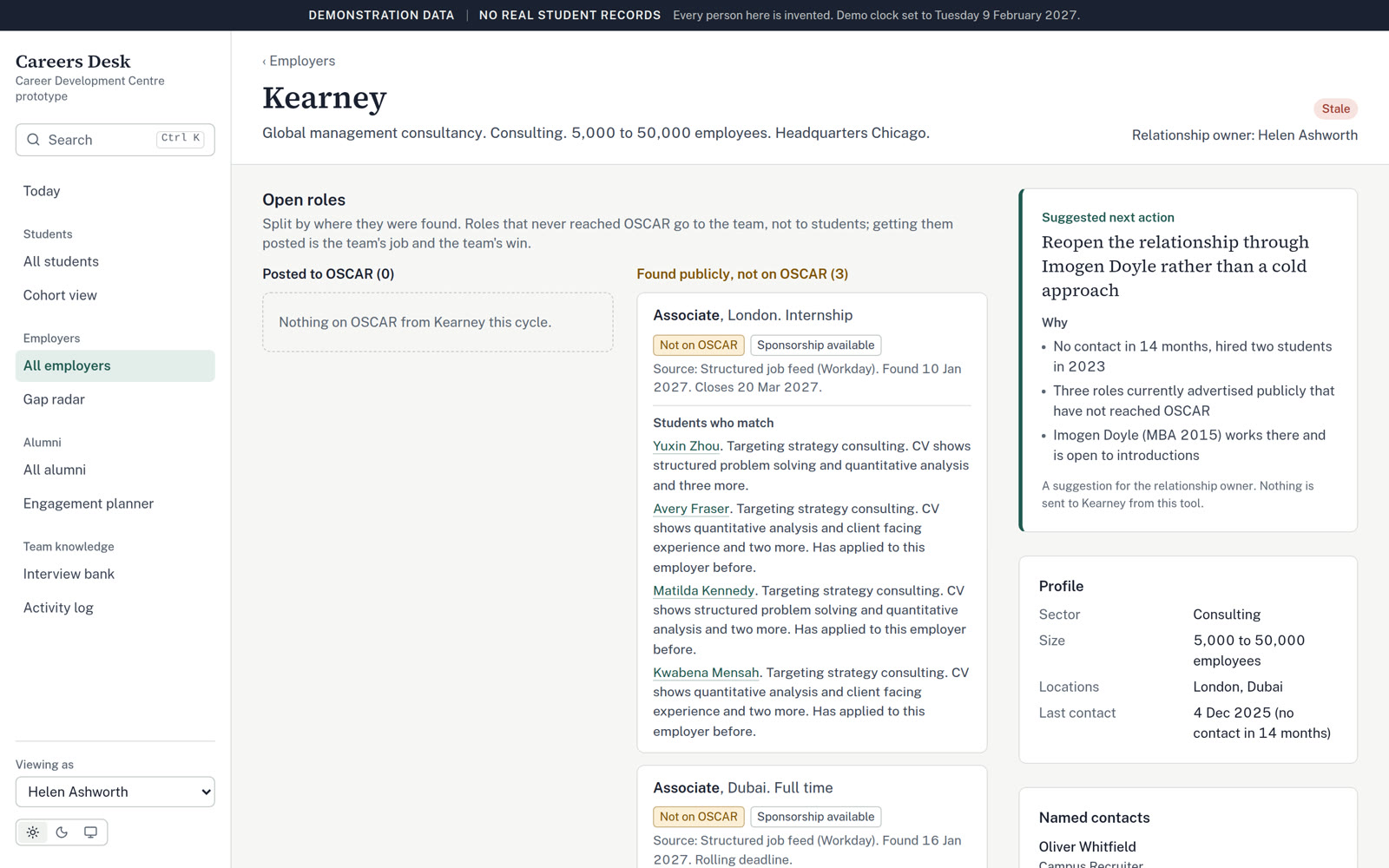
Employer and alumni pages
Who the school knows at each company, when it last spoke to them and what to do next, with stale relationships flagged.
Draft, never send
Anything written for an advisor is labelled as a draft, can be edited and copied, and has no send button.
Every person in these screens is invented, as the banner on each page says. Captured from a local build of the prototype.
why it's useful
Advisors start each day from one ranked list, with the reason for every item, and each student sees the roles that fit them. It is a working demonstration on invented data, so the first move needs nobody's permission to begin.
technical specs
- A typed data model: students with goals, CVs and applications through four stages (applied, first round, final round, offer); interactions with the actions agreed in them; employers with contacts, touches and roles; alumni with career steps and what they are willing to do.
- A seeded generator builds the whole dataset from one fixed seed: 120 students, 60 employers, 200 alumni and 411 interview reports, with five hand-written students anchoring the story.
- Everything said about a student is computed from activity, with its reasoning attached: days since the last one-to-one, rejections since, stages reached, overdue agreed actions, changes of target sector, days since the last login, and the age of the CV.
- Segments come from those signals, never from background: executing, stuck, undecided or disengaged, each with the reasons that put a student there, and they change as the activity does.
- The morning list scores every signal for urgency (a first round in two days with no mock interview ranks near the top) and shows the strongest reason for each person.
- Role matching scores each student against each role on target sector and role type, skills on the CV, and location, and a visa sponsorship mismatch rules a student out.
- The gap radar runs that match over every role found on employer career pages and job feeds but missing from the school's jobs board, and sorts them by how many students fit.
- The cohort view compares advisor hours by segment with the hours each segment's need implies, and shows where each segment drops out of the funnel.
- A frozen demo clock (Tuesday 9 February 2027) so relative dates never go stale. It runs offline, with no external services and no real student, alumnus or advisor anywhere.
- Before real data it would need the institution's data agreement, its own single sign-on, role-based access with audit logs, and UK or EU hosting.