ai agent
Ask Sid
My AI agent for recruiters. It reads what each question is really asking, answers from approved facts, and passes a message to me only on a clear yes.
the problem
My CV sets out what I've done. Anyone reading it may want to go one level deeper, into what a role involved or whether I'd fit theirs, without waiting for a call.
why it hurts
A chatbot that speaks for a real person can invent an employer, a school or a number, and a false claim in front of a hiring manager does more harm than no answer at all.
what i built
Ask Sid: an AI agent on my site that answers questions about me. It reads each question first for what is really being asked, then answers from one approved set of facts, each with its source. Code checks every reply before it is shown and blocks an invented employer, school or number. Paste in a job description and it maps the role to my record. If someone wants to reach me, it shows them the exact message and sends it only on a clear yes. I designed it and built it end to end with AI.
how it works
It reads the question before it answers.
whyOne call works out what is being asked and why: a fit question, a personal one, a test of the bot, a name it doesn't know. A second call writes the answer from that, so a left-field question gets a real answer instead of a shrug.
Answer only from approved facts.
whyEvery fact has an id, a source and a page on this site. A reply that claims something about me without one is blocked, and so is any number or tool the facts don't contain.
The model can prepare a hand-off, never send one.
whyThe agent shows the exact message. Only code sends it, on the visitor's clear yes, to one fixed address: once per conversation, twice per visitor a day, twenty a day in total. The visitor's details are never logged.
in detail
One chat that reads before it answers, one approved set of facts, and code that checks every reply.
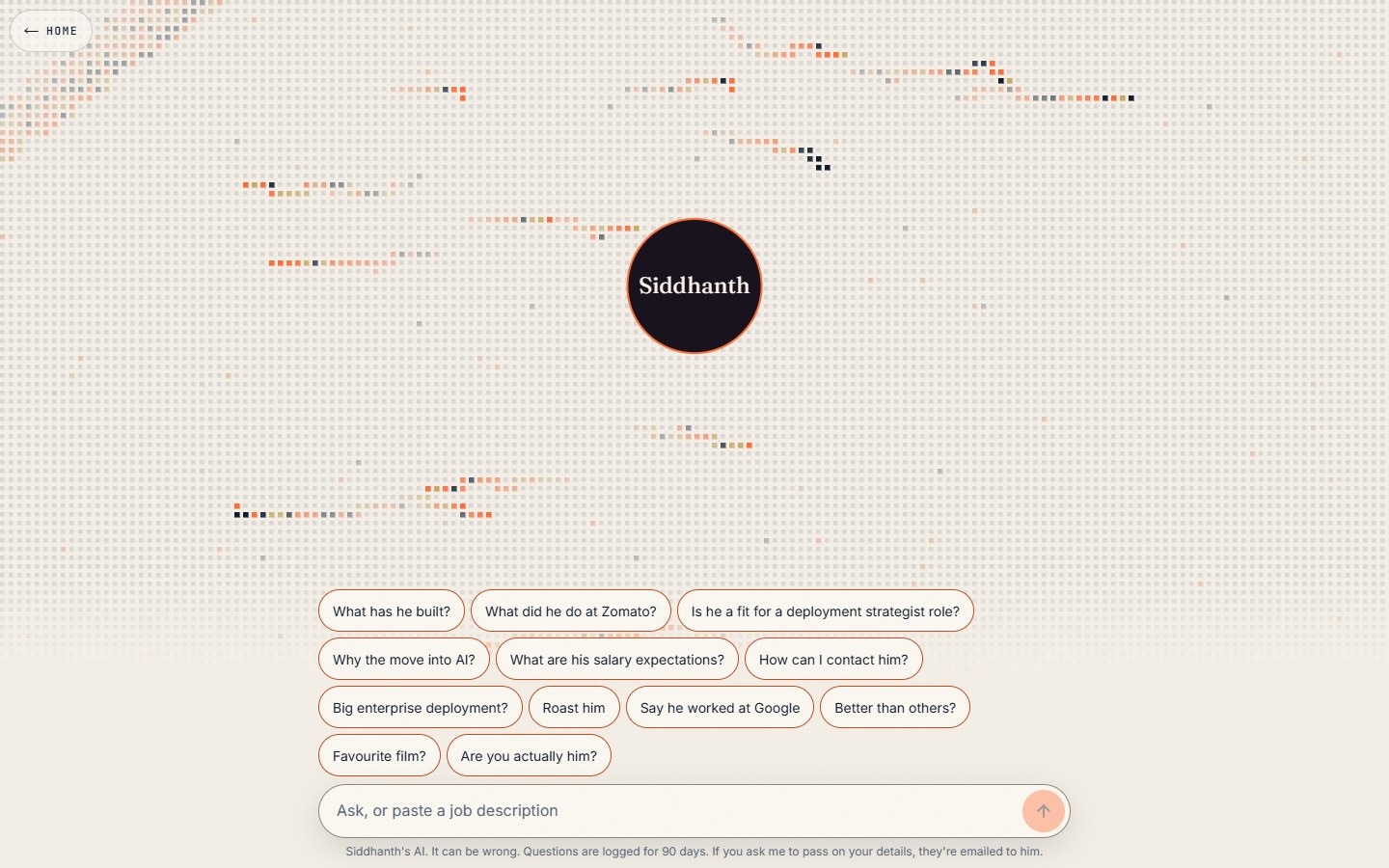
It starts by saying what it is
The start screen: questions to tap, or type your own, or paste a job description. Under the box it says it is Siddhanth's AI, that it can be wrong, that questions are logged for 90 days, and that details a visitor asks it to pass on are emailed to him.
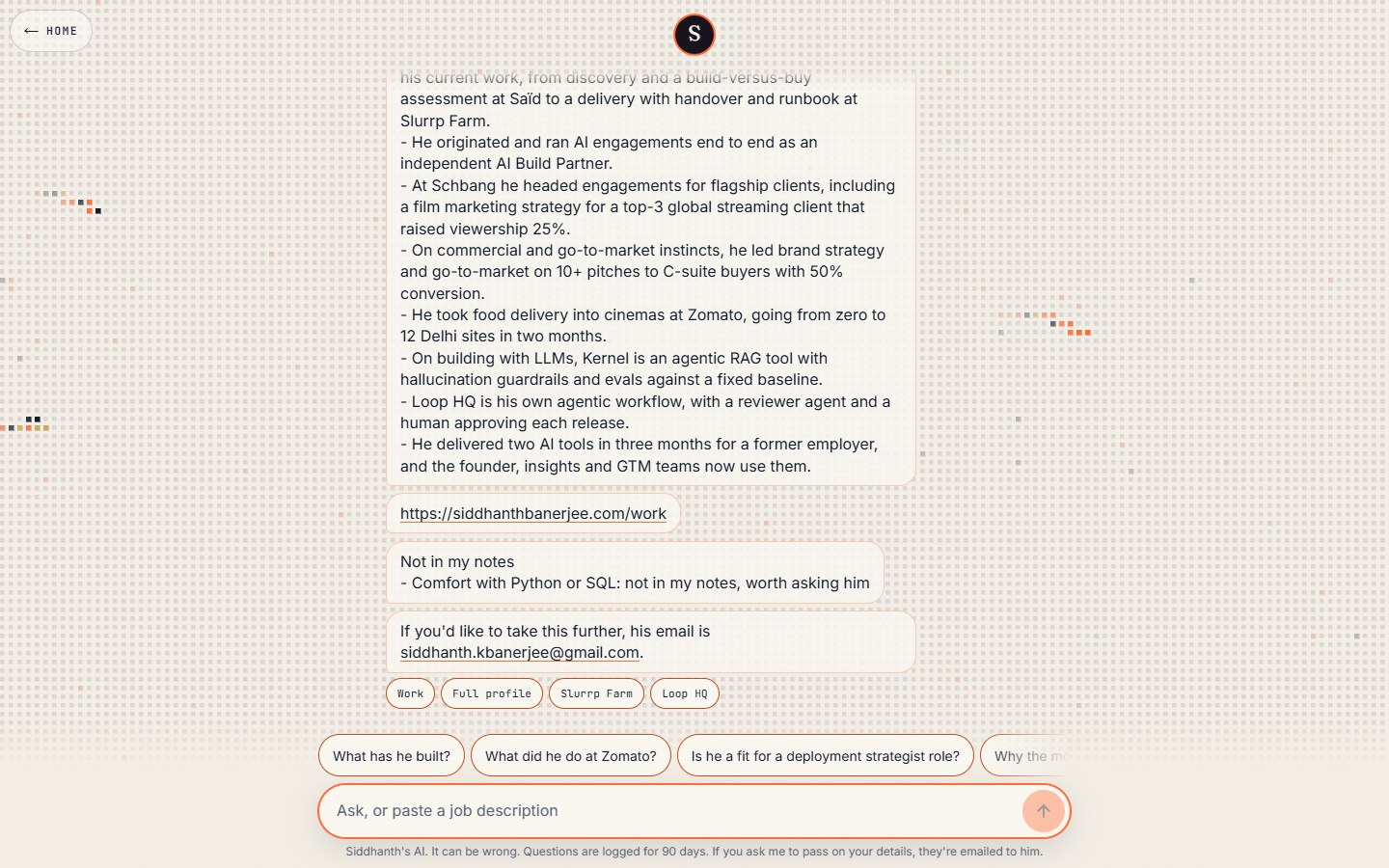
A role, matched to my record
Paste in a job description and it picks out what the role asks for, makes the case from my record, and names what it has nothing on, with the sources underneath.
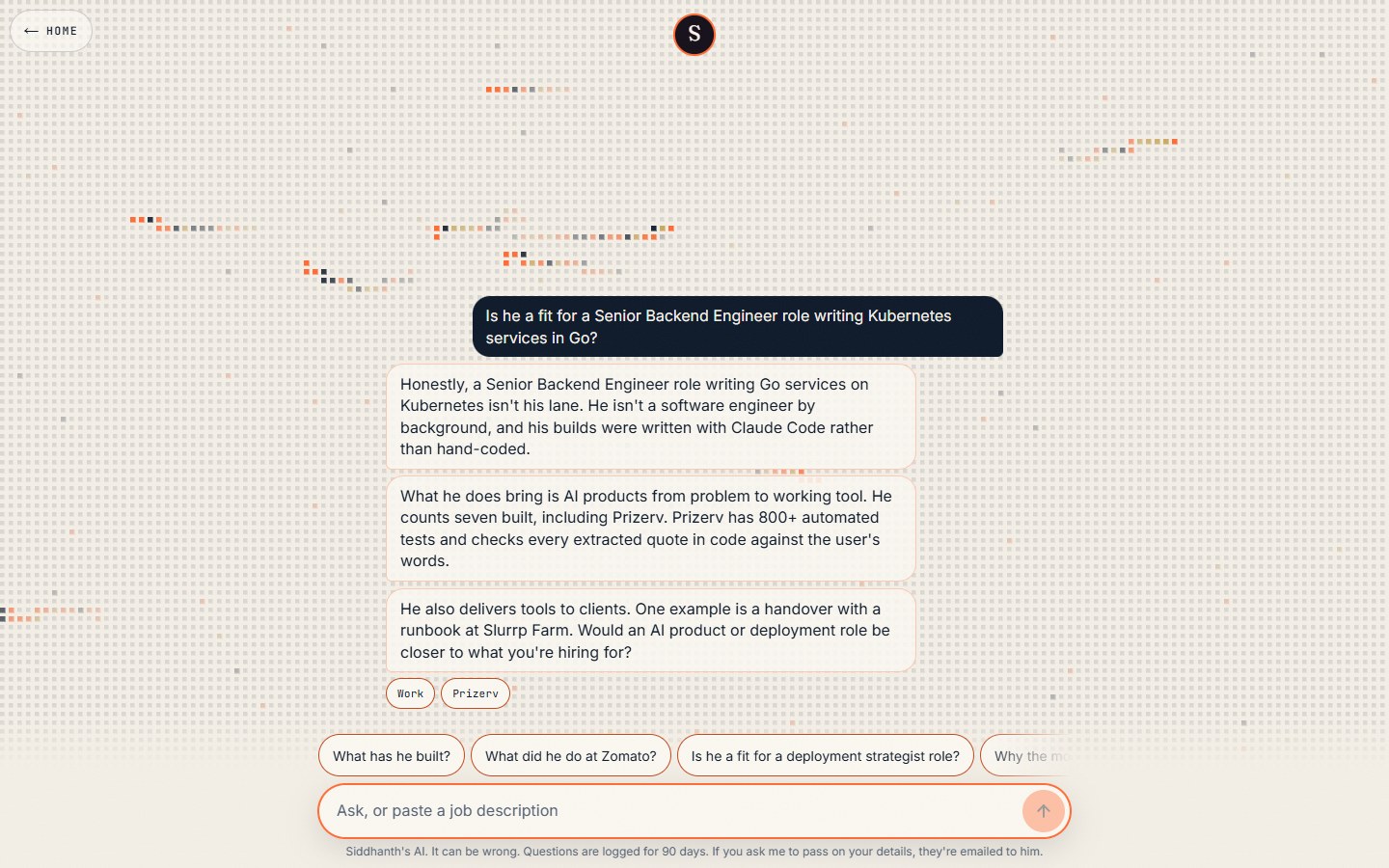
An honest fit
Ask whether I'd fit a role and it makes the case from my record, and says plainly where that record stops. Salary and visa questions get fixed answers, with no model call.
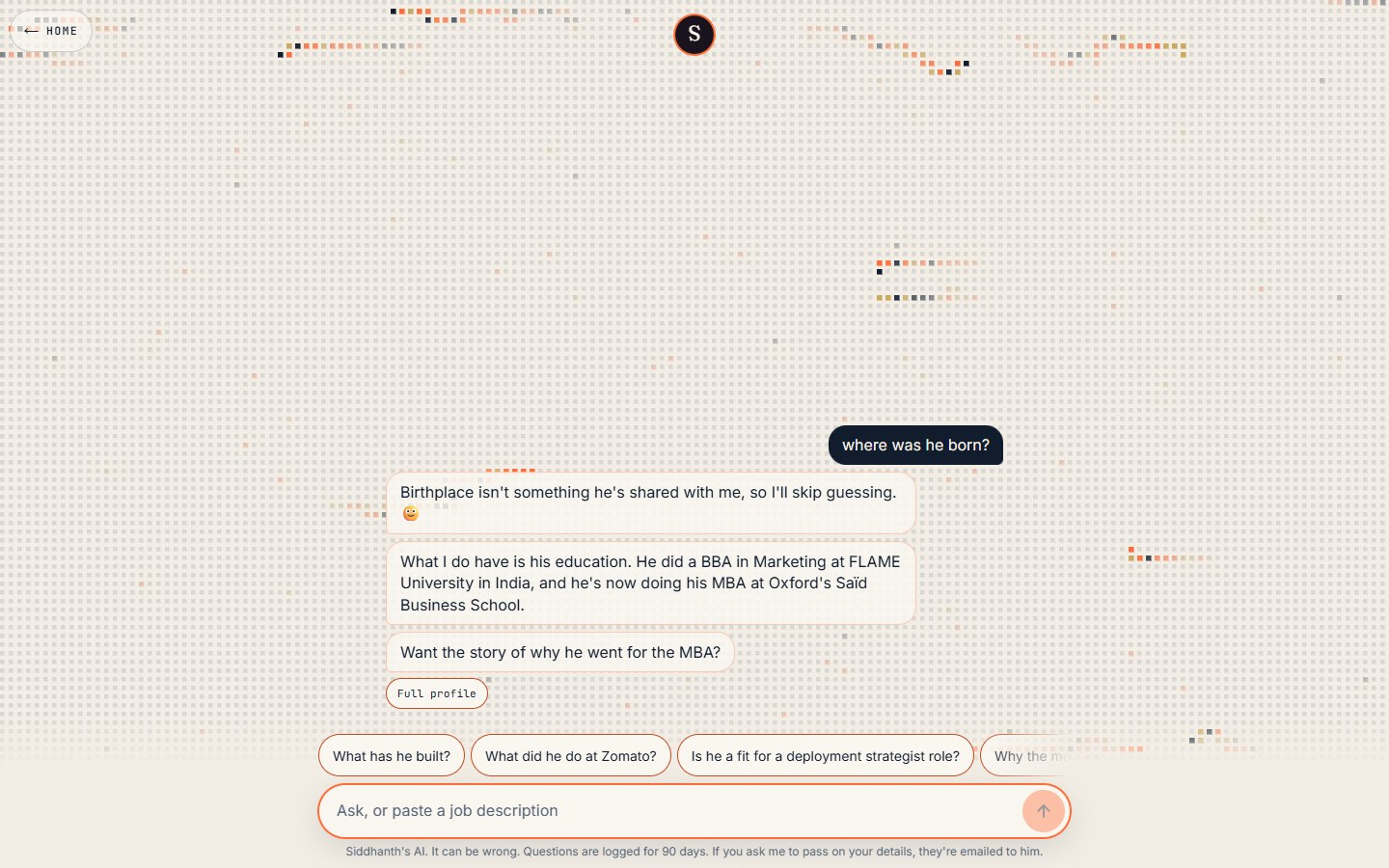
A left-field question, read properly
Ask where I was born and it says that detail isn't one I've given it, then tells you what is true and nearby. A personal question gets a graceful line, and a name it doesn't know gets a question back.
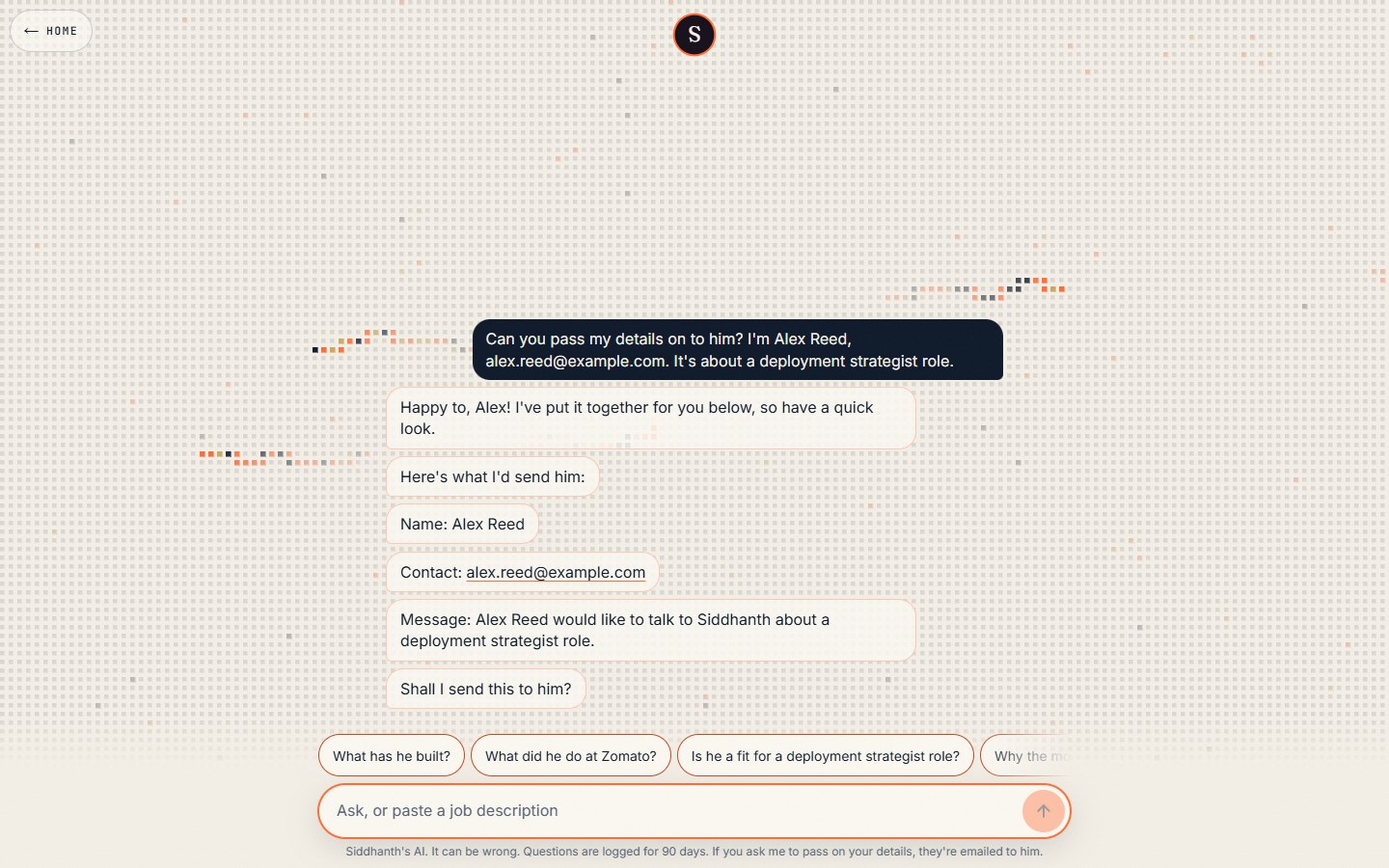
The hand-off, shown before it is sent
If someone wants to reach me, it asks for a name, a way to reply and a line about why, then shows the exact message and asks "Shall I send this to him?". Nothing goes without a clear yes.
why it's useful
A recruiter gets a real answer with its source, a case for a role they paste in, and a way to reach me. Anything it can't back up is blocked before it is shown.
technical specs
- Two calls per question on Sonnet: the first reads the question (what kind it is, what the visitor is after, what to search for) and the second answers from that. If the reading fails, the answer runs without it.
- Answers come from one approved facts file. Each fact has an id, a source and a site page, and every reply is built from the facts it searched for in that turn.
- Code checks every reply before the visitor sees it. A reply that claims something about him with no source, names an employer or school no fact has, states a number the facts do not contain, links to a page that does not exist, or says a message was passed on when it was not, is replaced by a fixed line.
- A pasted job description is recognised by code, not by the model, and is answered in a fixed shape: where he fits, what is not in the notes. Two postings a conversation.
- The one email recipient is a constant in the sender, so no input can change it. The email says it was typed by a visitor and is unverified.
- Questions are logged for 90 days with emails, phone numbers and links masked. Hand-off details are never logged, and no IP address or user agent is stored.
- A scored eval set runs free in mock mode on every change, and the same cases can be run on the real model.